 Nick Ambrose
My Journey Understanding the Purpose of Life
Toward the end of 2025, I started getting stuck on a question that felt too important to ignore:
What is the purpose of my life?
Not just what job I want or what goals I should chase next week. I mean the deeper question underneath all of that. What is the thing that should guide my decisions in the first place?
What bothered me most was that I could not accept the common answer: “The purpose of life is whatever you make of it.” That always sounded shallow to me. It treats purpose like a matter of taste, as if every way of spending a life is equally valid. I do not believe that. Some ways of living are clearly better than others. Some choices lead to flourishing, growth, connection, and meaning. Others lead to misery, waste, and harm. So no, I do not think the purpose of life is just whatever I decide to call it.
And once that clicked for me, I found it hard to focus on anything else. It felt impossible to move forward with my goals and ambitions while still being unclear on what any of it was for. If I am going to spend decades making choices, sacrificing things, and committing to certain paths over others, I want at least some idea of what I am optimizing for.
I am probably lucky that this question started bothering me at 23 instead of much later. Once I felt it clearly, I could not ignore it.
This is not a guide to how other people should live. It is my current attempt to answer the question for myself.
Narrowing the Question
I kept circling around two questions:
What is the meaning of life?
and
What is the purpose of life?
At first, those sounded interchangeable to me. But the more I thought about them, the more it seemed like they were different questions.
What is the meaning of life?
This one seems impossible for me to answer in any final sense. To answer it completely, you would almost need to be the creator of the universe. Nobody knows why conscious experience exists at all, or why any of us are here having it. The only thing I can say for sure is that I am having a conscious experience.
What is the purpose of life?
This question feels more workable, but only if I define “purpose” carefully.
Here is what I do not mean by purpose:
- I do not mean what life was designed to do.
- I do not mean the cosmic reason life exists.
- I do not mean some objective mission written into the universe.
What I mean is much more practical:
By “purpose,” I mean the end I choose to aim at. The thing I want to optimize for. The result I want my actions to move toward.
Once I defined the question that way, it finally felt answerable.
The Answer I Kept Coming Back To
As I read and thought more about this, many different answers seemed to point back to the same underlying idea:
Increase well-being.
That is a broad answer, but it may be the best one for such a broad question.
If that answer already feels sufficient, then there is probably no need to keep reading. For me, though, it was not satisfying until I tried to unpack it.
The definition of well-being I am working with is this:
Well-being is the overall quality of a person’s life as they experience it and live it.
I like this definition because it is broad enough to include happiness, health, connection, purpose, fulfillment, security, and freedom from unnecessary suffering.
Why I Keep Returning to Well-Being
One reason this idea stuck with me is that so many other common answers to the purpose-of-life question seem to fit inside it.
1. Connection with other people
One common answer is that the purpose of life is to connect with others: friendship, family, romance, community.
That answer makes sense to me. Social connection clearly matters for living a longer and better life. But I do not think “connection” by itself is enough. Relationships can also be destructive.
The real standard is not just whether a relationship exists, but whether it improves the well-being of the people involved. A relationship is good to the extent that it helps the people involved live better lives.
2. Having and raising children
Another common answer is that the purpose of life is to have children and raise them.
That is one of the biggest decisions a person can make. But even here, I still find myself framing the question in terms of well-being. Am I capable of giving my child a decent life? Can I support them emotionally and financially? Would bringing them into the world likely result in a life worth living for them?
Determining the morality of this choice must involve considering the well-being of the child and the people responsible for them.
3. Self-actualization
Another answer is self-actualization: becoming the most capable version of yourself.
This also seems to fit within a well-being framework. First, developing yourself makes you more useful to other people. A more disciplined, wise, and capable person can usually do more good than a scattered and unstable one. Second, the process of self-actualizing is rewarding in itself. Your individual well-being will improve when you move towards goals.
Clearly self-actualization is closely connected to well-being both for the individual and for others.
4. Pleasure
Some people argue that the purpose of life is pleasure. I understand the pull of that view, but I do not think pleasure alone is enough.
Pleasure matters. A good meal, a beautiful day, laughter with friends, music, love, and rest are all parts of a good life. But pleasure cannot be the whole story, because pleasure can also come apart from morality.
Take a sadist for example. For him, torturing a child would be an incredibly pleasurable experience. Obviously, nothing about that is good.
Pleasure has value, but it has to be checked by a broader concern for well-being.
5. Helping others
This one is the clearest. If the purpose of life is helping others, that is the same thing as increasing the well-being of others.
So after looking at all these different answers, I kept ending up in the same place. Different schools of thought emphasize different parts of life, but many of them seem to converge on the same deeper concern: how to increase the well-being of conscious beings.
Why That Was Not Enough for Me
Realizing that well-being matters was useful, but it did not solve my actual day-to-day problem.
If increasing well-being is the thing I want to optimize for, then I still need some practical framework for answering questions like:
- What should I do when values conflict?
- How much should I sacrifice for others?
- When should I follow rules, and when should I make exceptions?
- How should I prioritize myself, my family, my friends, and strangers?
That is where moral frameworks become useful.
The Framework That Makes the Most Sense to Me
There are many moral frameworks a person could adopt: utilitarianism, deontology, virtue ethics, care ethics, egoism, divine command theory, and others.
The one that currently resonates most with me is two-level utilitarianism.
Utilitarianism says the morally right action is the one that produces the most overall well-being. I find that attractive in principle because it lines up with the conclusion I had already been drifting toward.
But pure act-by-act utilitarianism is basically impossible to live out. Human beings are biased. We rarely have perfect information. We are bad at predicting consequences. And trying to calculate the outcome of an action in every situation is unrealistic.
That is why two-level utilitarianism appeals to me. It says I should operate on two levels:
- Everyday level: live by strong default rules such as honesty, keeping promises, avoiding harm, and treating people fairly.
- Critical level: in rare, high-stakes situations where I have unusually good information, step back and reason more directly about consequences.
I like this because it tries to keep the good part of utilitarianism while avoiding the trap of endless calculation of consequences.
I also think this explains why moral rules are so important. Rules matter because they are practical tools for us imperfect humans. They let me move through life with some reliability instead of constantly pretending I can compute the consequences of my actions.
Figuring out what rules to use is a major challenge. I think the best way to do this is to use the information and people around you. Ask a role model what rules they live their life by. Extract the good rules from ancient texts like the bible (and be sure to leave out the bad ones ).
Ask a simple question of each rule you come across:
Does this tend to improve well-being, or does it tend to damage it?
That is not a perfect test. But at this point in my life, it feels like a better starting point than drifting without any framework at all.
Of course, I know there are plenty of people who know far more philosophy than I do and would argue that two-level utilitarianism is not the right framework. They may be right. Maybe there is no single best moral framework. What seems clear to me is that even philosophers who have spent their lives thinking about these questions are not in agreement.
A Personal Framework for Prioritization
Even after getting this far, I still felt stuck on one last question:
How should I prioritize where to direct my effort?
If well-being matters for everyone, then why is it so natural to care most about myself and the people closest to me? Is that selfishness, moral failure, biology, or just reality?
The rough framework I have landed on is pictured as a set of expanding circles:
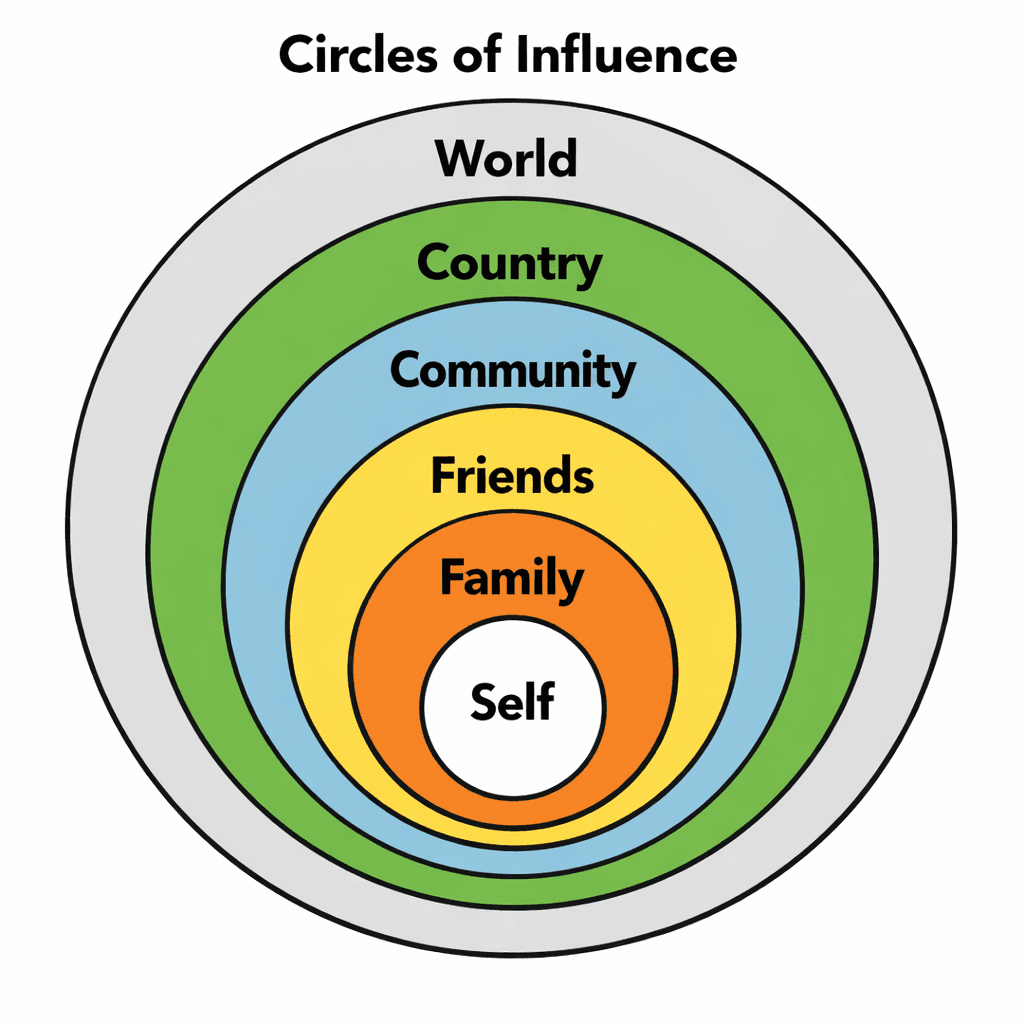
My current view is that it makes sense to move outward from the center over time.
Not because people farther away matter less, but because effectiveness usually depends on foundation. If I am emotionally unstable, resentful, undisciplined, and unable to manage my own life, I will probably not have much positive impact on anyone else. If my closest relationships are in chaos, it will be harder to serve wider circles well. A person who cannot carry their own life with some steadiness is not in a strong position to reliably help others.
So for me, focusing on myself first is not selfish. It is about becoming a stable instrument for doing good.
The same logic seems to apply outward. Healthy families are usually in a better position to support friendships and communities. Strong communities are usually in a better position to contribute to the wider society. The outer circles still matter, but the inner circles often provide the base that makes meaningful action possible.
That said, there is room for nuance here. Some suffering is more important: If a stranger is drowning and my sister has a stubbed toe, I’ll help the stranger. Once again, we see everything must be framed within a broader concern for well-being.
I also think this framework works with innate human motivation. We are tuned to care for those close to us . That fact does not automatically determine what is morally right, but it does matter if I care about building a life that is actually livable. Working with human nature may be the more realistic path to long-term moral action.
I agree with Peter Singer that the end goal is to expand the circle to all humans. I’ll act in accordance with this when working in my closer circles. I won’t do things that benefit my close circle at the expense of outer circles, since this is counter productive to the ultimate goal.
Where I’ve Landed, For Now
If I had to summarize my current view as simply as possible, it would be this:
I do not think I can know the meaning of life. But I do think I can choose a purpose for my own life. The best purpose I have found so far is to orient my actions toward increasing well-being. The moral framework that currently helps me do that is a rule-guided form of utilitarian thinking. And the practical strategy that makes the most sense to me is to build outward from the circles where I have the most immediate responsibility and influence.
I expect parts of this to change. The point of writing this publicly is to make my current thinking visible so that it can be challenged.
I also know there is very little in this essay that is entirely new. In my reading, I came across a line from Ludwig Wittgenstein that captures this well: “The problems are solved, not by giving new information, but by arranging what we have always known.”
If you think this framework is confused, incomplete, or mistaken in some other important way, I would like to hear why!
© Nicholas Ambrose.
Comments
Loading comments...